
Representatives from Niue, Tuvalu, Palau and the Marshall Islands joined their counterparts here in the Cook Islands last week to discuss national progress in developing climate information systems, early warning systems for extreme weather events, and community-level resilience to climate change.
They were gathered together in Rarotonga for the week-long 9th Programme Steering Committee meeting of the United Nations CIS-Pac5 project, officially known as ‘Enhancing Climate Information & Knowledge Services for Resilience in 5 Island Countries of the Pacific Ocean’.
Established to combat the increasing threat of climate-related impacts and hazards such as cyclones, coastal storm surges, droughts, floods and sea-level rise across these five countries, CIS-Pac5 is a US$49.9 million project led by the United Nations Environment Programme (UNEP) and funded by the Green Climate Fund, an international climate financing body.
Last week’s annual meeting was the largest of its kind to date, with more than 50 attendees from the five participating nations, and also including representatives of UNEP; the APEC Climate Center from South Korea; the Secretariat of the Pacific Regional Environment Programme from Samoa; Earth Sciences New Zealand (ESNZ); the Red Cross/Crescent Climate Centre; the University of Hawaii; and the Pacific Community (SPC).
Discussions throughout the week addressed the final delivery of real, tangible benefits for the nations involved, from coastal inundation early warning systems and strengthened ocean/climate monitoring networks, to improved climate forecasting tools and community outreach initiatives.
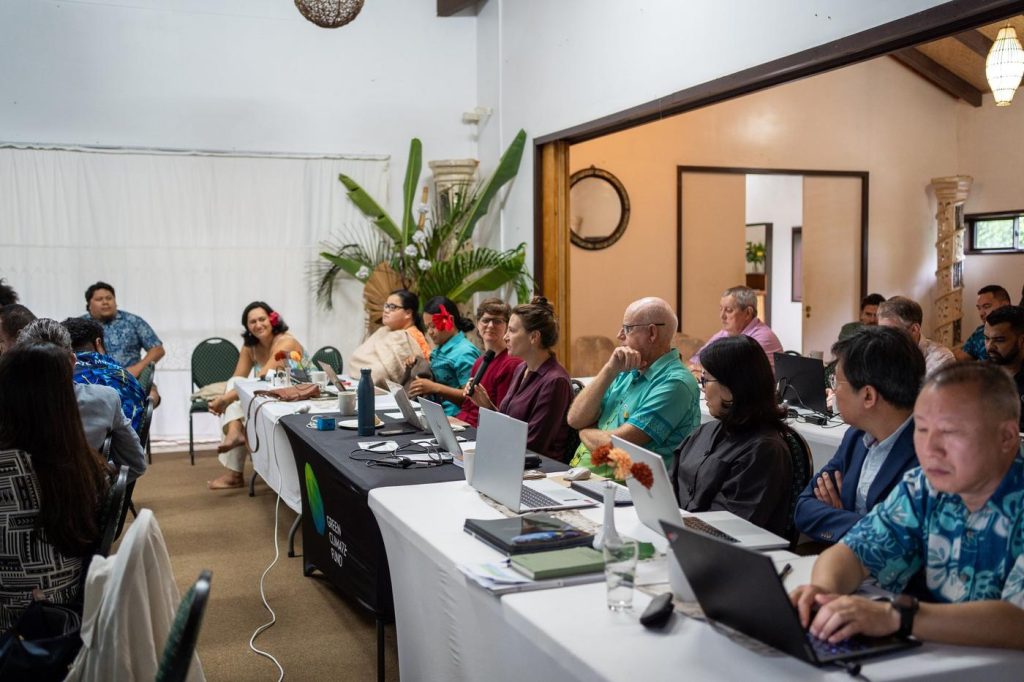
The final day of meetings concluded with presentations from our own Climate Change Cook Islands (CCCI), Cook Islands Meteorological Service (CIMS), and Emergency Management Cook Islands (EMCI), to showcase some of the outcomes that CIS-Pac5 funding has made possible, including:
- The translation of climate-change terminology into local Maori dialects for Pa Enua.
- Surveys and mapping of Pa Enua buildings, water tanks and populations, including special needs requirements, to strengthen disaster response.
- The reinstatement of the CIMS upper-air weather observation system.
- The upgrading of Automatic Weather Stations throughout the Pa Enua, and installation of new aviation weather observation equipment for several islands.
- Seasonal climate forecasting improvements and outreach programmes such as the National Climate Outlook Forum and several national tropical cyclone simulation exercises.
According to CCCI Director Wayne King, another positive outcome of the CIS-Pac5 project has been increased collaboration between local agencies CCCI, CIMS and EMCI.
“There are strong connections between our respective areas of responsibility under this project, but the open lines of communication were often fragmented and covered a wide scope of interactions,” said Director King.
“The CIS-Pac5 work has helped change not just communications, but also how we can coordinate better, and it makes sense that we continue this cooperation on into the future.”
Following their last formal meeting day, the CIS-Pac5 Steering Committee meeting concluded the week with a field trip to attend the official opening of the newly built Upper-Air Sounding Station at the CIMS site in Nikao, and the relaunch of their upper-air weather observation programme.
Speaking at the new station’s opening ceremony, Deputy Prime Minister Albert Nicholas described it as “an important milestone for our country”.
“As we all know, the Cook Islands is on the frontline of climate change, extreme weather events, changing rainfall patterns, and increasing climate variability that poses real and ongoing risks to our people, our environment and our economy.
“In this context, accurate, timely and high-quality meteorological and climate data is absolutely critical, and the data collected here does not only benefit the Cook Islands, it strengthens forecasting capability across the Pacific.”
Looking ahead, future CIS-Pac5 project activities are also being planned, in partnership with various technical support agencies.
Later this year CCCI will collaborate with ESNZ on a multi-week ocean research voyage throughout the Cook Islands Exclusive Economic Zone to collect baseline oceanographic data sets relevant to climate change impacts. CIMS will also deliver the Cook Islands’ first weather observation radar in partnership with UNEP and the International Civil Aviation Organization, a significant advancement in early-warning infrastructure for the country.
 Government of the Cook Islands